
A 13-Year Commitment: The Story of Professor Shi’ai Xu in Qinghai with the Salt Lake Chemical Industry
Recently, a letter of gratitude from the Qinghai Provincial People’s Government brought a remarkable story back into the spotlight. This story traces the journey of Shi’ai Xu, a professor from the School of Materials Science and Engineering at ECUST. What began as a brief six-month assignment has evolved into a 13-year endeavor. Over more than 4,000 days, he has dedicated his expertise to advancing Qinghai University and the local salt lake chemical industry.
Taking Root on the Plateau: A 13-Year Commitment
In 2013, ECUST asked Xu to participate in the national pairing assistance program in Qinghai. He readily agreed. “Initially, it was just supposed to be a six-month mission,” he recalled. However, the experience quickly changed his plans.
Upon arrival, he was captivated by the region’s vast salt lake resources but also struck by the urgent need for industrial development. Recognizing the relevant of his expertise, Qinghai University strongly encouraged him to stay. Step by step, a brief visit turned into a long-term commitment. From 2015 to 2022, he served as the Dean of the School of Chemical Engineering at Qinghai University. Today, he continues to lead the Collaborative Innovation Center for Salt Lake Resources Chemistry and Process Engineering.
Turning a Magnesium Waste Challenge into Valuable Resources
The Qarhan Salt Lake in Qinghai is a crucial national resource. However, extracting potassium and lithium leaves behind over 200 million cubic meters of high-magnesium brine each year. This difficult-to-treat byproduct, often referred to locally as a “magnesium hazard”, has become a critical bottleneck for sustainable growth.
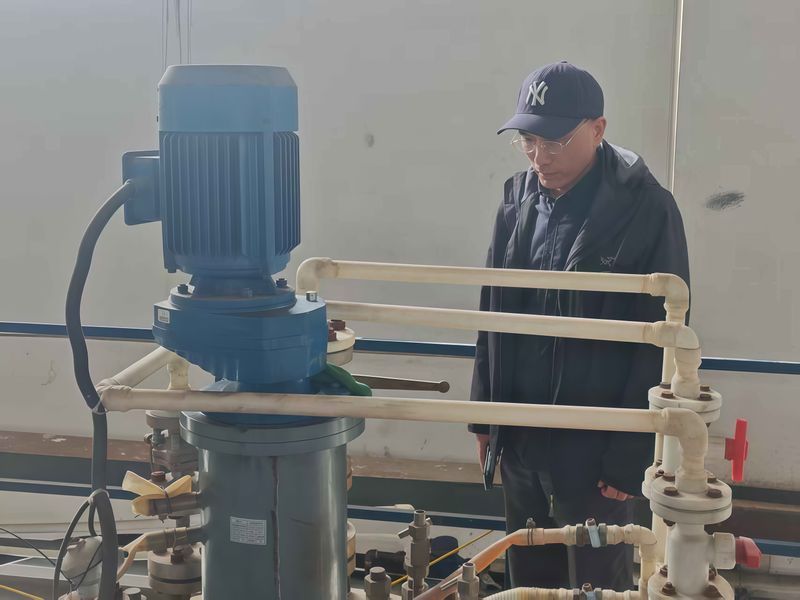
To address this challenge, Xu led his team to secure a key project from the National Natural Science Foundation of China. Their goal was the high-value utilization of magnesium chloride resources. By pioneering a green hydrothermal synthesis process, the researchers successfully converted the waste brine into high-quality anhydrous magnesium carbonate. In 2025, they completed a 500-liter pilot-scale verification. This achievement not only filled a major technological gap in preparing anhydrous magnesium carbonate from bischofite-rich salt lake brine but also earned a spot among Qinghai University’s Top 10 Scientific Advances of the year.
To bridge the gap between laboratory research and commercial application, he also spearheaded the construction of a pilot-scale platform and a chlorine balance laboratory. Both became fully operational in 2025, clearing the final hurdles for industrialization.
Building Educational Bridges
Beyond his research, Xu deeply understands that the key to the China’s Western Region Development Strategy lies in talent. Leveraging his administrative background at ECUST, he successfully revitalized the “1+2+1” joint undergraduate training program by aligning curricula and resolving credit recognition barriers. This program serves as a collaborative model where students complete their first and final years at Qinghai University, and spend two intermediate years at ECUST to access advanced academic resources, ultimately earning a degree from their home institution. Today, the program supports 20 to 30 Qinghai University students annually, creating a powerful model for inter-school collaboration.
In graduate education, he aligned his students’ research directly with the strategic needs of the local chemical industry. Through the joint efforts of his team, Qinghai University’s chemistry and materials science disciplines entered the top 1% of the global ESI rankings in 2024. Building on this momentum, the School of Chemical Engineering successfully secured a doctoral degree program, which officially began enrollment in 2025.
A Mutual Achievement
Reflecting on his 13 years in Qinghai, Xu notes that the experience has been mutually rewarding. The immense trust from the local government, the significant transformation of research facilities, and the rapid growth of young scholars have brought him profound fulfillment. “Behind all these achievements is the firm support of the university,” he stated. “This is a mutual achievement driven by a shared vision.”
From the banks of the Huangpu River to the Qinghai-Tibet Plateau, Xu’s perseverance exemplifies the spirit of serving the country through scientific research. His story is a compelling example of ECUST’s Pairing Assistance efforts and its commitment to the high-quality development of China’s western regions.
?